
Outdoor furniture shipping costs can change which product is commercially viable. A chair with a lower purchase price may cost more to transport per unit if its packaging wastes space. Before comparing suppliers, importers and distributors should compare packed volume, loading quantity and the full scope of each freight quotation.
This guide provides a practical worksheet for outdoor furniture buyers sourcing from China. All prices and carton sizes in the examples below are illustrative—not DONGMEI quotations, confirmed product specifications or current freight rates.
1. Collect packing information before comparing prices
Start with a consistent packing sheet for every shortlisted SKU. Product dimensions describe the furniture in use; carton dimensions describe what occupies shipping space. These are different measurements, especially for assembled armchairs, nesting chairs and tables with removable legs.
| Information to request | Why it matters |
|---|---|
| External carton length, width and height | Provides the basis for packed-volume calculations |
| Units per carton and cartons per set | Converts shipment volume into a comparable cost per item or set |
| Gross weight per carton | Helps assess weight limits and handling requirements |
| Stacking orientation and maximum stack height | Shows whether a theoretical layout is physically usable |
| Pallet, cushion and accessory packaging | Captures space that can be missed in a frame-only estimate |
| Loading photographs or a SKU-specific layout | Supports the proposed container quantity |
For outdoor dining chairs, ask whether the stated volume assumes individual cartons, nested stacks or another packing method. For dining sets, check that the calculation includes every chair, the tabletop, legs, cushions and hardware.
2. Calculate CBM to compare outdoor furniture shipping costs
For a rectangular carton measured in metres:
Carton CBM = length × width × height
CBM per unit = total carton CBM ÷ units in that packing group
If dimensions are supplied in centimetres, divide the product of the three measurements by 1,000,000 to obtain cubic metres. A hypothetical carton measuring 80 × 60 × 100 cm occupies 0.48 m³. If it contains four chairs, the average packed volume is 0.12 m³ per chair.
Do not multiply the dimensions of one unpacked chair by the number of nested chairs. Instead, measure the finished, protected stack. Where one set uses several cartons, add their volumes before dividing by the number of complete sets. Keep a written link between the packing method and the quoted quantity so later packaging changes trigger a recalculation.
3. Validate the container loading plan
Dividing nominal container capacity by carton CBM gives a screening estimate, not a guaranteed loading quantity. Door clearance, carton orientation, uneven shapes, weight distribution, permitted stacking and protective materials can all affect the final result.
For equipment reference, see Hapag-Lloyd’s 40-foot high-cube container specifications. The carrier notes that equipment specifications vary by manufacturer. Confirm the actual equipment and loading constraints with your forwarder and loading team rather than treating one published specification as universal.
Request a loading layout for the actual mix of SKUs. A single-model loading quantity does not automatically remain achievable when tables, chairs and accessories are combined. If the packing plan changes after sample approval, ask for revised carton measurements and loading quantities before booking.
4. Allocate outdoor furniture shipping costs consistently
Use the same cost scope across products. For an initial volume-based comparison, divide the relevant shipment cost by the total packed volume, then multiply by each product’s packed volume. This is an allocation method for comparing a shipment—not a freight tariff or a complete landed-cost calculation.
Allocated shipping cost per unit = shipment cost ÷ shipment CBM × CBM per unit
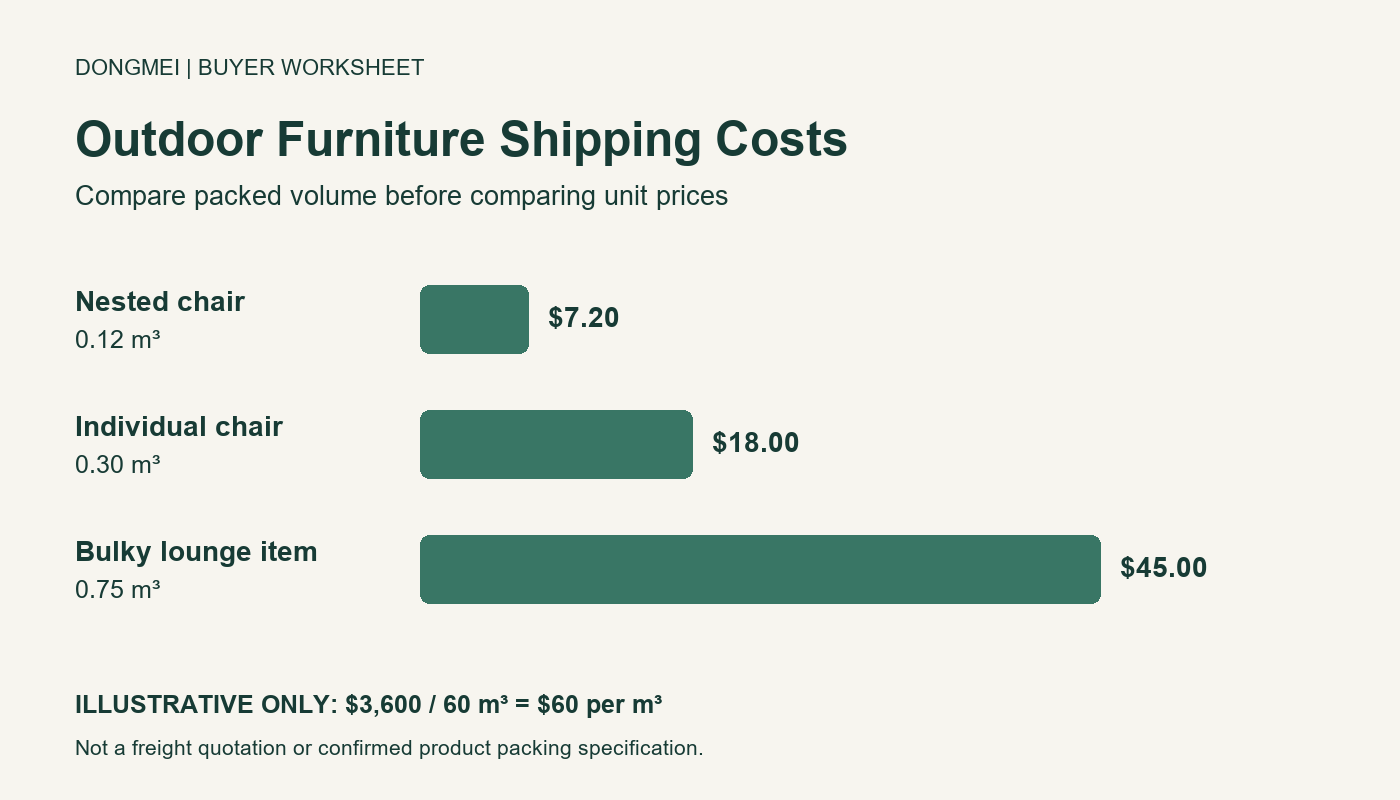
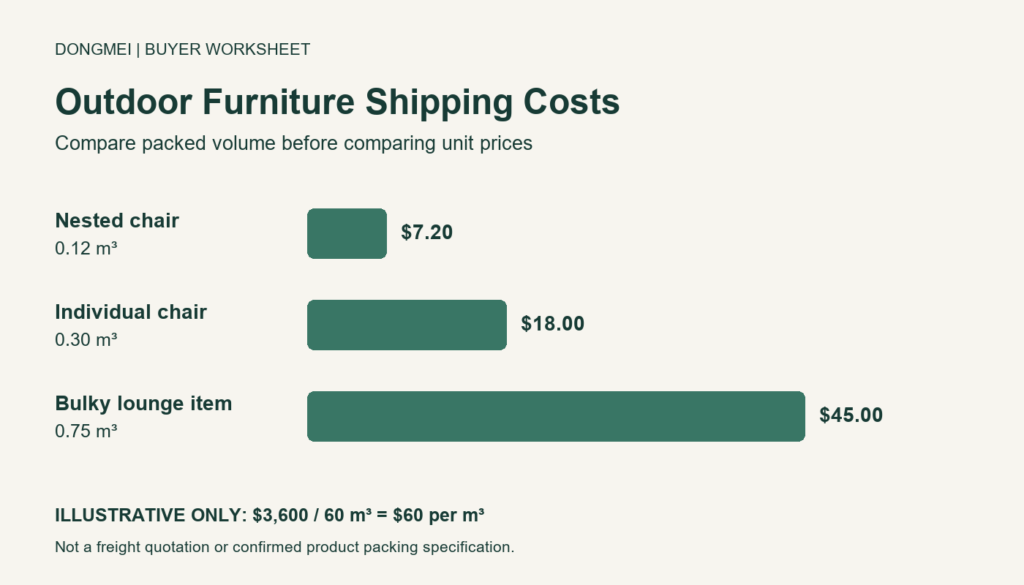
Suppose a hypothetical shipment has 60 m³ of packed cargo and USD 3,600 of transport charges within a clearly agreed scope. The allocated rate is USD 60 per m³:
| Illustrative product | Packed CBM per unit | Allocated transport per unit |
|---|---|---|
| Nested dining chair | 0.12 m³ | USD 7.20 |
| Individually packed chair | 0.30 m³ | USD 18.00 |
| Bulky lounge item | 0.75 m³ | USD 45.00 |
These figures demonstrate arithmetic only. They do not show comparable products, actual packing performance or a current route quotation. Weight-sensitive cargo, special handling and minimum charges may require a different allocation. If comparing full-container options, also calculate total freight divided by the confirmed number of saleable units.
A packaging improvement can reduce allocated outdoor furniture shipping costs, but check its wider effect. Disassembled furniture may need clearer instructions, additional assembly labour or different protective packaging. Lower volume is valuable only if the product arrives in acceptable condition and can be handled efficiently.
5. Compare outdoor furniture shipping costs on the same basis
Give each forwarder the same cargo-ready date, origin, destination, packing list and service requirements. Ask which origin charges, destination charges, customs-related services, delivery and insurance are included or excluded. Identify the agreed delivery point and trade term in writing, including the named place.
For less-than-container-load shipments, request the chargeable weight-or-volume basis, minimums and both ends’ handling charges. For full-container-load shipments, confirm the equipment type and ask what happens if the cargo is delayed or cannot fit the proposed plan. Rates and conditions can change; compare quotations with matching validity periods.
Build a separate landed-cost worksheet for purchase cost, logistics, applicable duties and taxes, destination delivery and other relevant expenses. Treatment of tax and customs depends on the market and transaction. Have your broker confirm the applicable classification and charges instead of assuming one rate applies to all furniture.
6. Send a complete quotation checklist
A precise inquiry makes it easier to obtain usable outdoor furniture shipping costs. Send the following details together:
- Product links or SKUs, quantities and the number of complete sets.
- Requested materials, finishes and any customization.
- Confirmed or provisional carton dimensions, gross weights and packing photos.
- Destination country, port or delivery postcode.
- Required arrival window and expected cargo-ready date.
- Preferred shipment arrangement and the cost items you want included.
Explore the DONGMEI product catalogue to prepare a shortlist. For broader supplier comparisons, read our outdoor furniture sourcing guide. DONGMEI supports product selection and supplier coordination; packing specifications, availability and order arrangements require confirmation for the selected items.
Frequently asked questions
Are stackable chairs always cheaper to ship?
No. Compare the finished packing group, protective packaging, units per carton and confirmed loading quantity. A stackable design can reduce volume, but its savings depend on how it is actually packed and transported.
Can I calculate a container quantity from CBM alone?
CBM is useful for an initial comparison. A reliable quantity also needs a practical layout, carton orientation, stacking limits, door clearance and weight checks. Ask the loading team to validate the proposed configuration.
Does the lowest FOB price give the lowest landed cost?
No. Compare the same delivery scope and include packing, logistics, applicable import charges and destination handling. A lower product price can be offset by larger cartons or higher handling costs.
What should I send DONGMEI for a packing review?
Send the product SKU, intended quantity, destination and any packaging requirements. Existing packing details can then be reviewed with the relevant supplier. Missing or provisional measurements should be confirmed before a final shipment calculation.
Request packing information for your shortlist
Request product and packing information, or email info@dongmeioutdoor.com. Include your SKUs, quantities and destination so the next discussion can focus on the right specifications and shipment assumptions.